We Use CookiesWe use cookies to enhance the security, performance, functionality and for analytical and promotional activities. By continuing to browse this site you are agreeing to our privacy policy

10 Best Telescopes For Kids

From leading brands and best sellers available on the web.
By clicking on a link to a third party's website, log data is shared with that third party.

Our Top Picks

#1

Winner

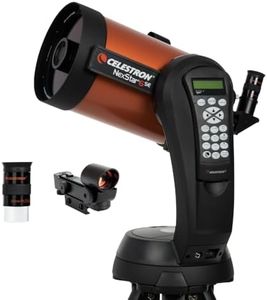
Celestron 11068 NexStar 6SE Computerised Schmidt-Cassegrain Telescope with Fully Automated Mount, SkyAlign Technology and XLT Coating, Black/Orange

Rating
10.0
Chosen by1,358
Durability
Ease of Use
Mount Type
Durability
The telescope delivers superb optical quality with sturdy, heavy-duty construction built to last.
Ease of Use
Setup is straightforward and user-friendly, with the hand controller functioning like a joystick to easily point and track objects.
Mount Type
The fully automated GoTo mount reliably finds and tracks thousands of celestial objects, making stargazing fun and accessible.
Accessories
Accurate alignment is simple with the included bubble level and SkyAlign technology, ensuring precise object location.
Magnification
While the telescope offers impressive magnification, pairing it with additional eyepieces enhances the viewing experience.
Portability
The tripod is stable and portable enough for indoor assembly and short-distance transport, though the total weight may challenge younger children.
Aperture
Optics provide clear and detailed views of the moon, planets, and some deep-sky objects, but aperture limits deep-sky observation capabilities.

The Celestron 11068 NexStar 6SE is a computerized telescope designed to be beginner-friendly while still offering features that can satisfy more experienced young stargazers. Its 6-inch (150mm) aperture is quite large for a kids' telescope, allowing it to gather plenty of light and show detailed views of planets, the moon, and some deep-sky objects. The telescope has a 1500mm focal length, which translates into good magnification when paired with the included eyepieces.

This model stands out for its fully automated GoTo mount, which can automatically find and track over 40,000 celestial objects. This feature is great for kids and beginners who might struggle with manual searching, making stargazing more fun and less frustrating. The computerized single fork arm mount is sturdy and fairly easy to set up, supported by Celestron's SkyAlign technology for quick and accurate alignment.

While the telescope is more compact than many other 6-inch models, it still weighs about 9.5 kg (21 lbs) with tripod, so it might be a bit heavy for very young children to handle alone. The telescope breaks down into parts for transport but is better suited for use at home or on short trips rather than frequent carrying over long distances. Assembly is straightforward but may need some adult help. Durability is solid, given its steel tripod and robust design, though care should be taken with the computerized mount and optics. The manual focusing system is simple and effective but requires some practice to master. Extras include a built-in StarPointer red dot finderscope and free Starry Night software, which can help kids learn the night sky interactively. If you want a kid-friendly telescope that will grow with their interest and provide reliable computerized tracking, the NexStar 6SE is a strong option. It may not be ideal if you need something very lightweight or super simple without electronics.

Rating
10.0
Chosen by1,358
Durability
Ease of Use
Mount Type
Durability
The telescope delivers superb optical quality with sturdy, heavy-duty construction built to last.
Ease of Use
Setup is straightforward and user-friendly, with the hand controller functioning like a joystick to easily point and track objects.
Mount Type
The fully automated GoTo mount reliably finds and tracks thousands of celestial objects, making stargazing fun and accessible.
Accessories
Accurate alignment is simple with the included bubble level and SkyAlign technology, ensuring precise object location.
Magnification
While the telescope offers impressive magnification, pairing it with additional eyepieces enhances the viewing experience.
Portability
The tripod is stable and portable enough for indoor assembly and short-distance transport, though the total weight may challenge younger children.
Aperture
Optics provide clear and detailed views of the moon, planets, and some deep-sky objects, but aperture limits deep-sky observation capabilities.
#2

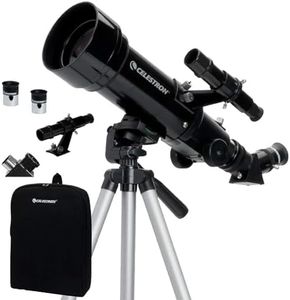
Celestron 21035 Travel Scope 70 Portable Refractor Telescope Kit with Backpack, Black

Rating
7.9
Magnification
Mount Type
Portability
Magnification
The included eyepieces provide good quality magnification, enhancing views of the moon and planets like Saturn and Jupiter.
Mount Type
The tripod is a weak point, making night-time astronomy tricky; switching to a more robust camera tripod can significantly improve stability.
Portability
The lightweight frame and convenient backpack make it easy to store and transport, which is a huge plus for parents.
Ease of Use
Assembly is straightforward, taking only about 10 minutes, and while focusing on stars can be challenging, the moon is perfectly captured.

The Celestron 21035 Travel Scope 70 is a portable refractor telescope designed with kids and beginners in mind. With an aperture of 70mm, it provides decent light-gathering capability for observing both celestial and terrestrial objects. The inclusion of two eyepieces (20mm and 10mm) allows for varying magnifications, making it versatile for different viewing scenarios. The Alt-Az mount is simple and intuitive, ideal for young users who are new to telescopes, though it may limit more advanced tracking of objects in the sky.

One of its standout features is the lightweight frame and custom backpack, which enhances its portability, making it easy for kids to carry and set up the telescope wherever they go. The manual focus and built-on StarPointer red dot finderscope further add to its user-friendly design, enabling easier targeting of objects. However, a potential drawback is its durability; while it is designed to be lightweight, it may not withstand rough handling as well as some more robust models.

The included accessories, such as the full-height tripod, SkyPortal app, and Starry Night Basic Edition software, add considerable value, providing educational resources. The Celestron 21035 Travel Scope 70 is a solid choice for young astronomers, offering a good balance of ease of use, portability, and educational value, though it might require careful handling to ensure longevity.

Rating
7.9
Magnification
Mount Type
Portability
Magnification
The included eyepieces provide good quality magnification, enhancing views of the moon and planets like Saturn and Jupiter.
Mount Type
The tripod is a weak point, making night-time astronomy tricky; switching to a more robust camera tripod can significantly improve stability.
Portability
The lightweight frame and convenient backpack make it easy to store and transport, which is a huge plus for parents.
Ease of Use
Assembly is straightforward, taking only about 10 minutes, and while focusing on stars can be challenging, the moon is perfectly captured.
#3

Telescopes for Adults Astronomy, 80mm Aperture 600mm Refractor Telescope for Kids & Beginners, Compact and Portable Travel Telescopio with Backpack

Rating
7.6
Ease of Use
Aperture
Ease of Use
Setup is incredibly straightforward, making it ideal for complete beginners.
Aperture
The telescope delivers impressive optical quality for its category and price point.

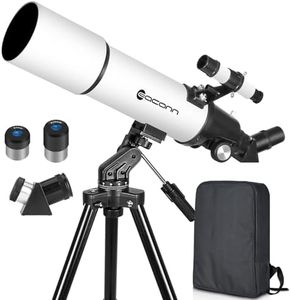
The EACONN 80mm refractor telescope is a solid choice for kids and beginners interested in astronomy. Its 80mm aperture is quite good for a beginner’s scope, allowing it to gather enough light to show clear and bright images of the moon, planets, and some brighter stars. The included magnifications (30x to 66x) are suitable for starting out but won’t reveal very fine details, which is normal at this price and category. The alt-azimuth mount with rough adjustment and gimbal positioning makes it straightforward to aim and track objects, which is helpful for younger users still learning to navigate the night sky.

Portability is a strong point here: the telescope comes with an adjustable tripod and a carrying backpack, making it easy to take outdoors or on trips. Assembly is simple with clear instructions and video help, which lowers the frustration often faced by beginners. The package also includes useful accessories like two eyepieces, a 5x24 finder scope for easier object location, and a phone adapter for capturing images through the lens.

Durability seems reasonable for casual use, and the telescope is waterproof, adding some protection against the elements. However, the fixed focal length and center focus design mean fine focusing might require patience, and the optical quality, while good, won’t match more advanced or expensive models. Also, the mount lacks motorized tracking, so manual adjustments are necessary. This telescope suits kids and beginners who want a portable, easy-to-use starter telescope with decent optics and accessories. It’s great for moon and planet observation and can double as a travel scope. Those seeking deeper space views or advanced features might find it limiting, but for a first-time astronomy gift, it offers good value and enjoyable family stargazing experiences.

Rating
7.6
Ease of Use
Aperture
Ease of Use
Setup is incredibly straightforward, making it ideal for complete beginners.
Aperture
The telescope delivers impressive optical quality for its category and price point.

Buying Guide for the Best Telescopes For Kids

Choosing a telescope for kids can be a fun and educational experience. The right telescope can spark a child's interest in astronomy and science. When selecting a telescope, it's important to consider factors such as ease of use, durability, and the type of celestial objects your child is interested in observing. Here are some key specifications to consider when picking the best telescope for your child.
ApertureThe aperture is the diameter of the telescope's main lens or mirror. It determines how much light the telescope can gather, which affects the brightness and clarity of the images. For kids, a smaller aperture (around 60-80mm) is usually sufficient and easier to handle. Larger apertures can provide better views but may be more cumbersome and expensive. Consider your child's age and strength when choosing the aperture size.
MagnificationMagnification refers to how much larger the telescope can make objects appear. While high magnification might seem appealing, it's not always better. Too much magnification can make images blurry and difficult to focus. For kids, a telescope with a magnification range of 20x to 50x is typically adequate. It's more important to have a clear, stable image than to zoom in too much.
Mount TypeThe mount is what holds the telescope steady and allows it to move. There are two main types: altazimuth and equatorial. Altazimuth mounts move up-down and left-right, making them simpler and more intuitive for kids to use. Equatorial mounts are more complex and better suited for tracking objects across the sky, but they can be challenging for beginners. For kids, an altazimuth mount is usually the best choice.
PortabilityPortability is important if you plan to take the telescope to different locations. Lightweight and compact telescopes are easier for kids to carry and set up. Consider telescopes made of durable materials that can withstand some rough handling. A portable telescope encourages more frequent use and exploration.
Ease of UseA telescope that is easy to set up and use will be more enjoyable for kids. Look for telescopes with simple assembly instructions and minimal adjustments. Some telescopes come with user-friendly features like red dot finders or smartphone adapters, which can make locating objects easier. The simpler the telescope is to use, the more likely your child will enjoy using it.
DurabilityKids can be rough on their belongings, so a durable telescope is a must. Look for telescopes made from sturdy materials that can withstand drops and bumps. Protective features like lens caps and padded cases can also help extend the life of the telescope. A durable telescope will last longer and provide more value over time.
AccessoriesSome telescopes come with additional accessories like extra eyepieces, star charts, or educational materials. These can enhance the learning experience and make stargazing more fun. Consider what accessories are included and whether they add value for your child's interests. Extra eyepieces can provide different magnification options, while educational materials can help guide their exploration of the night sky.