We Use CookiesWe use cookies to enhance the security, performance, functionality and for analytical and promotional activities. By continuing to browse this site you are agreeing to our privacy policy

10 Best Telescopes For Beginners

From leading brands and best sellers available on the web.
By clicking on a link to a third party's website, log data is shared with that third party.

Our Top Picks

#1

Winner

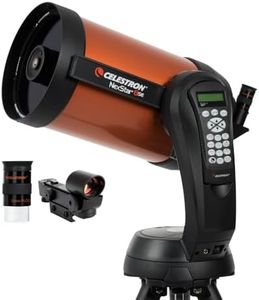
Celestron 11069 NexStar 8SE Computerised Schmidt-Cassegrain Telescope with Advanced GPS, Astroimaging and AutoAlign Features, Black/Orange

Rating
10.0
Chosen by1,121
Aperture
Mount Type
Portability
Aperture
The telescope delivers outstanding brightness and clarity, making celestial objects appear vividly detailed and bright.
Mount Type
Achieving a perfectly level mount is essential for stable tracking and smooth sessions, especially on uneven or soft ground.
Portability
Portability is reasonable for its size, allowing easy transport fully assembled within a home or short distances, though it is not ultra-lightweight for long treks.

The Celestron NexStar 8SE is a beginner-friendly telescope that stands out thanks to its large 8-inch aperture. This means it can gather plenty of light, allowing you to see planets and deep-sky objects with good clarity. Its focal length of 2000mm provides strong magnification potential, which is great for detailed views but may require some patience to focus manually. The built-in GoTo mount is a big help for newcomers—it automatically finds and tracks over 40,000 stars and planets, so you don't have to be an expert to explore the night sky. The mount uses an altazimuth design, which is easier to operate for beginners compared to more complex mounts.

Portability is decent; it breaks down into parts and comes with a sturdy steel tripod, but at about 11 kilograms, it’s not the lightest option for carrying long distances. The setup is simplified by SkyAlign technology, helping you get started quickly without complicated calibration. Bonus software included offers an interactive way to learn the sky. On the downside, the manual focus might feel tricky at first, and the battery-powered system means you’ll need to keep spare batteries handy if you plan extended sessions. Also, while the telescope is compact for its aperture, beginners seeking ultra-lightweight gear for travel might find it a bit heavy.

This telescope provides a solid balance between power and ease of use, making it a strong pick for those ready to dive deeper into astronomy with some guidance.

Rating
10.0
Chosen by1,121
Aperture
Mount Type
Portability
Aperture
The telescope delivers outstanding brightness and clarity, making celestial objects appear vividly detailed and bright.
Mount Type
Achieving a perfectly level mount is essential for stable tracking and smooth sessions, especially on uneven or soft ground.
Portability
Portability is reasonable for its size, allowing easy transport fully assembled within a home or short distances, though it is not ultra-lightweight for long treks.
#2

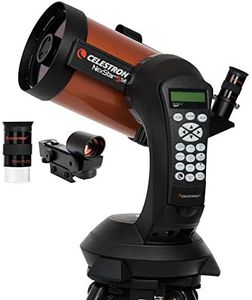
Celestron 11036 NexStar 5SE Computerised Schmidt-Cassegrain Telescope with Automated GoTo Mount, SkyAlign Technology and Steel Tripod, Black/Orange

Rating
9.7
Aperture
Magnification
Mount Type
Aperture
The telescope delivers impressive brightness and clarity, making celestial objects like Jupiter's Red Spot vividly visible at high magnifications.
Magnification
The telescope delivers impressive brightness and clarity, making celestial objects like Jupiter's Red Spot vividly visible at high magnifications.
Mount Type
The computerized GoTo mount with its extensive object database and SkyAlign technology transforms setup into a straightforward process once you get familiar with it.
Portability
The telescope’s size and weight strike a balance between portability and performance, though it’s not the lightest model available for beginners.

The Celestron NexStar 5SE is a solid choice for beginners interested in astronomy. Its 5-inch (127 mm) aperture lets you see planets and many celestial objects clearly by gathering a good amount of light, which is important for detailed viewing. The focal length of 1250 mm gives you decent magnification options, especially combined with the included 25mm eyepiece, helping you zoom in on stars and planets. One of its biggest strengths is the computerized GoTo mount with a database of over 40,000 objects—this means the telescope can automatically find and track stars and planets for you, which is great if you’re new to locating objects in the night sky. Its SkyAlign technology makes setup quick and straightforward, so you can spend more time observing rather than fiddling with complicated adjustments.

The single fork arm design and steel tripod provide sturdy support, and although the telescope weighs nearly 8 kg, it breaks down into manageable parts for transport, making it fairly portable for its size. Manual focusing allows you control over clarity, though it requires some practice. One downside is that it relies on 8 lithium metal batteries, which you’ll need to replace periodically, so having a power option might be a consideration. Also, while it’s very capable, the 5SE isn’t the lightest or smallest beginner model, so if portability is your top priority, there are lighter options. The included Starry Night software is a helpful bonus for learning the night sky.

This telescope balances ease of use with powerful features, making it ideal for beginners who want a reliable, computer-assisted experience and don’t mind a bit of setup and weight.

Rating
9.7
Aperture
Magnification
Mount Type
Aperture
The telescope delivers impressive brightness and clarity, making celestial objects like Jupiter's Red Spot vividly visible at high magnifications.
Magnification
The telescope delivers impressive brightness and clarity, making celestial objects like Jupiter's Red Spot vividly visible at high magnifications.
Mount Type
The computerized GoTo mount with its extensive object database and SkyAlign technology transforms setup into a straightforward process once you get familiar with it.
Portability
The telescope’s size and weight strike a balance between portability and performance, though it’s not the lightest model available for beginners.
#3

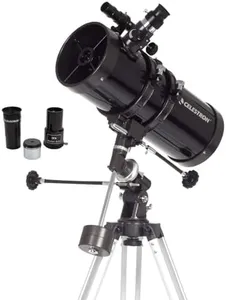
Celestron 31045 AstroMaster 130EQ Newtonian Reflector Telescope, Dark Blue

Rating
7.9
Aperture
Magnification
Mount Type
Aperture
The 130mm aperture provides excellent views of celestial bodies, with users noting impressive sights of the moon and even the moons of Jupiter.
Magnification
The included eyepieces, while basic, serve well for starting observations, though many find upgrading beneficial for better clarity and range.
Mount Type
The equatorial mount, although requiring a learning curve, is praised for its stability and effective tracking once mastered.
Portability
The telescope's portability is balanced by its compact design, making it suitable for home use despite not being the lightest option.

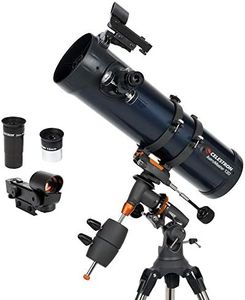
The Celestron AstroMaster 130EQ Newtonian Reflector Telescope is a solid choice for beginners interested in exploring astronomy. Its 130mm aperture is large enough to provide clear and bright images of celestial objects, which makes it easier for newcomers to spot planets and star clusters. The focal length of 650mm offers sufficient magnification, especially with the included 20mm and 10mm eyepieces, allowing users to switch between different viewing options.

The mount type is a CG-3 Equatorial, which is more complex than simpler altazimuth mounts found in some beginner models. While this may offer better tracking of celestial objects, it requires some learning to use effectively. The slow-motion control knobs do aid in precise adjustments, which is a definite plus for achieving a steady view.

Portability is a mixed bag for this telescope. Weighing around 17 pounds, it's not the lightest, but the design is compact enough for home use. The quick, tool-free setup is a welcomed feature, making it user-friendly for families or individuals who aren't interested in a complicated assembly process.

Included accessories like the StarPointer red dot finderscope enhance usability by helping locate objects in the sky, and the free download of an astronomy software adds value for those wanting to expand their stargazing experience.

However, the manual focus and power source mean that the telescope lacks some automated features found in other models. The package dimensions might also be a consideration for those with limited storage space.

In essence, the Celestron AstroMaster 130EQ is tailored for beginners who are willing to invest some time in learning to use an equatorial mount. With its sturdy build and quality optics, it provides a rewarding experience for those new to astronomy.

Rating
7.9
Aperture
Magnification
Mount Type
Aperture
The 130mm aperture provides excellent views of celestial bodies, with users noting impressive sights of the moon and even the moons of Jupiter.
Magnification
The included eyepieces, while basic, serve well for starting observations, though many find upgrading beneficial for better clarity and range.
Mount Type
The equatorial mount, although requiring a learning curve, is praised for its stability and effective tracking once mastered.
Portability
The telescope's portability is balanced by its compact design, making it suitable for home use despite not being the lightest option.

Buying Guide for the Best Telescopes For Beginners

Choosing a telescope as a beginner can be an exciting journey into the world of astronomy. The right telescope will open up the universe for you, allowing you to explore the night sky and observe celestial objects in detail. When selecting a telescope, it's important to consider factors such as ease of use, portability, and the types of celestial objects you are most interested in observing. Understanding the key specifications of telescopes will help you make an informed decision and ensure that you choose a model that suits your needs and interests.
ApertureAperture refers to the diameter of the telescope's main optical component, which can be a lens or a mirror. It is one of the most important specifications because it determines how much light the telescope can gather. The more light it gathers, the better you can see faint objects. Aperture sizes can range from small (around 60mm) to large (over 200mm). For beginners, a telescope with an aperture between 70mm and 130mm is usually sufficient. This range offers a good balance between portability and the ability to see a variety of celestial objects, such as the Moon, planets, and some deep-sky objects.
Focal LengthThe focal length of a telescope is the distance from the main optical component to the point where the image is brought into focus. It affects the magnification and field of view of the telescope. A longer focal length provides higher magnification but a narrower field of view, which is ideal for observing planets. A shorter focal length offers a wider field of view, which is better for viewing larger areas of the sky, such as star clusters. Beginners might prefer a telescope with a moderate focal length, which provides a good balance for viewing a variety of objects.
MagnificationMagnification is how much larger a telescope can make an object appear. It is determined by the combination of the telescope's focal length and the eyepiece used. While high magnification might seem appealing, it's not always better. Too much magnification can result in a blurry image if the telescope's aperture isn't large enough to support it. For beginners, it's important to have a range of eyepieces that offer different magnifications, allowing you to adjust based on what you're observing. A good starting point is a telescope that can provide magnifications between 50x and 150x.
Mount TypeThe mount is what holds the telescope and allows you to point it at different parts of the sky. There are two main types: altazimuth and equatorial. Altazimuth mounts are simpler and easier to use, making them ideal for beginners. They move up and down and left to right, similar to a camera tripod. Equatorial mounts are more complex and are designed to follow the rotation of the Earth, which is useful for long-term tracking of objects. Beginners might prefer an altazimuth mount for its simplicity and ease of use.
PortabilityPortability refers to how easy it is to transport and set up the telescope. This is an important consideration if you plan to take your telescope to different locations for stargazing. Smaller telescopes are generally more portable and easier to handle, making them a good choice for beginners who want to explore different observing sites. Consider the weight and size of the telescope, as well as how easy it is to assemble and disassemble, to ensure it fits your lifestyle and observing habits.