We Use CookiesWe use cookies to enhance the security, performance, functionality and for analytical and promotional activities. By continuing to browse this site you are agreeing to our privacy policy

10 Best Beginners Telescopes

From leading brands and best sellers available on the web.
By clicking on a link to a third party's website, log data is shared with that third party.

Our Top Picks

#1

Winner

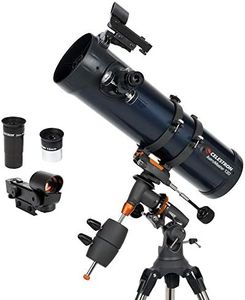
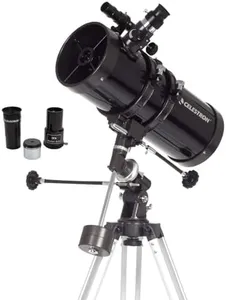
Celestron 31045 AstroMaster 130EQ Newtonian Reflector Telescope, Dark Blue

Rating
10.0
Chosen by1,146
Mount Type
Optical Design
Mount Type
The equatorial mount requires patience to master but offers stable viewing once set up correctly.
Optical Design
The 10mm lens provides impressive views of celestial bodies, making it a good starting point for stargazing.

The Celestron 31045 AstroMaster 130EQ is a beginner-friendly telescope that offers a solid introduction to stargazing with its 130mm aperture, which is decent for observing celestial objects like the moon and planets. This Newtonian reflector telescope uses fully-coated glass optics, enhancing image clarity and brightness, which is a standout feature for the price point. It's equipped with a manual German Equatorial mount, allowing smooth and precise tracking of objects across the sky, though it may require some learning to master its use. The telescope's focal length of 650mm means you get a good balance between magnification and field of view, which is ideal for beginners exploring various celestial objects.

Despite its capabilities, the AstroMaster 130EQ is relatively lightweight, making it portable and easy to transport, which is great for those who want to take it to different viewing locations. Setup is straightforward with no tools required, saving beginners from potential frustration. The included accessories, such as two eyepieces and a StarPointer red dot finderscope, add value by enhancing the telescope's usability right out of the box.

On the downside, the manual operation might not provide the ease of use some beginners crave, especially when compared to computerized models that automatically align and track objects. Additionally, while the equatorial mount is excellent for tracking, it could be challenging for complete novices to set up correctly at first.

The Celestron AstroMaster 130EQ is an excellent starter scope, balancing performance with ease of use. It's well-suited for beginners who are willing to spend a bit of time learning to operate the manual mount and want a telescope that can deliver clear, bright images of celestial wonders.

Rating
10.0
Chosen by1,146
Mount Type
Optical Design
Mount Type
The equatorial mount requires patience to master but offers stable viewing once set up correctly.
Optical Design
The 10mm lens provides impressive views of celestial bodies, making it a good starting point for stargazing.
#2

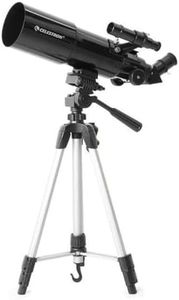
Celestron 22030 Travel Scope Portable Refractor Telescope with 80mm lens, Fully-Coated Glass Optics, Bonus Astronomy Software Package and Digiscoping Smartphone Adapter

Rating
9.4
Aperture
Focal Length
Mount Type
Aperture
The optics deliver satisfying views of the moon, planets, and some brighter deep-sky objects, making astronomy accessible to beginners.
Focal Length
The supplied eyepieces provide good magnification for beginners, though the 3x Barlow lens is often too strong for this model's capabilities.
Mount Type
The included tripod is lightweight but lacks stability and precision, so upgrading to a sturdier tripod greatly improves the viewing experience.
Portability
Portability is a strong advantage, with the lightweight design and included backpack making it easy to carry for outdoor adventures.
Optical Design
The refractor design offers clear, right-side-up images, which is helpful for terrestrial viewing and beginners learning the night sky.

The Celestron 22030 Travel Scope is a beginner-friendly telescope that offers an 80mm aperture, which is quite good for a portable refractor. This size lets you see a fair amount of detail on the moon, planets, and some brighter deep-sky objects without being too bulky. It has a fixed 400mm focal length, providing a decent balance between magnification and a wide field of view, which is helpful when you're just starting and learning to locate objects in the sky. The alt-azimuth mount is simple to use, allowing smooth up-and-down and side-to-side movement, and includes a clutch for easy and accurate pointing — perfect for beginners who want straightforward manual control.

Portability is a strong point here; the telescope is lightweight at about 4.5 pounds and comes with a full-height tripod and a backpack, making it easy to carry on trips or outdoor adventures. The refractor design with fully-coated glass optics ensures clear, bright images with minimal maintenance. It comes with two eyepieces (20mm for low power and wide views, 10mm for higher magnification), which cover basic viewing needs without overcomplicating things.

Added bonuses like the Starry Night software help beginners learn the night sky, and the smartphone adapter lets you try digiscoping, capturing images through the telescope using your phone. The main drawback is the manual focus and fixed focal length, which means you might outgrow it as you advance, and it may not reach the highest magnifications for deep-sky objects. For someone new to astronomy wanting a portable, easy-to-use, and versatile telescope, this Travel Scope represents a solid choice that balances good optics with convenience and educational extras.

Rating
9.4
Aperture
Focal Length
Mount Type
Aperture
The optics deliver satisfying views of the moon, planets, and some brighter deep-sky objects, making astronomy accessible to beginners.
Focal Length
The supplied eyepieces provide good magnification for beginners, though the 3x Barlow lens is often too strong for this model's capabilities.
Mount Type
The included tripod is lightweight but lacks stability and precision, so upgrading to a sturdier tripod greatly improves the viewing experience.
Portability
Portability is a strong advantage, with the lightweight design and included backpack making it easy to carry for outdoor adventures.
Optical Design
The refractor design offers clear, right-side-up images, which is helpful for terrestrial viewing and beginners learning the night sky.
#3

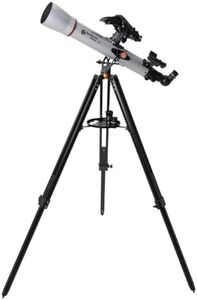
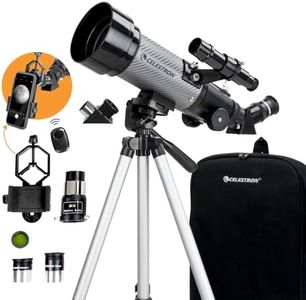
Celestron 22035 Travel Scope DX 70mm Portable Refractor Telescope with Fully-Coated Glass Optics, Backpack, Astronomy Software Package, and Digiscoping Smartphone Adapter

Rating
8.5
Aperture
Mount Type
Portability
Aperture
The 70mm aperture and included eyepieces deliver bright, clear views of the Moon, planets like Saturn and Jupiter, and some deep-sky objects such as the Orion Nebula and M31 galaxy under good conditions.
Mount Type
The supplied tripod is lightweight and portable but lacks the stability and fine control needed for steady astronomical observations, often prompting users to upgrade to a sturdier camera tripod for night viewing.
Portability
This telescope excels as a versatile, portable scope suitable for both daytime terrestrial viewing and casual nighttime astronomy, making it ideal for beginners who want multi-use functionality.
Optical Design
Manual focusing requires some practice, especially for stars and planets, but the 45-degree prism makes daytime and low-angle viewing comfortable.

The Celestron Travel Scope DX 70mm is a beginner-friendly refractor telescope that stands out for its portability and ease of use. With a 70mm aperture, it offers brighter and clearer views than smaller models, making it suitable for seeing the Moon, planets, and some land objects. The focal length around 400-500mm helps provide good magnification with the included 20mm and 10mm eyepieces, giving both low and high power viewing options.

Its altazimuth mount is simple to handle, allowing easy up/down and left/right movement, which is excellent for beginners who want quick setup and intuitive tracking of objects. The telescope comes as a complete kit, including a sturdy full-height tripod, a smartphone adapter, and a Bluetooth remote to capture images—features that add fun and convenience, especially for users wanting to take photos without complicated equipment. The included backpack enhances its portability, making it easy to carry outdoors or on trips.

The optical design is a classic refractor with fully-coated glass lenses, which helps deliver decent image quality without complicated maintenance. Manual focusing may take some practice for new users, and while the 70mm aperture is good for beginners, it limits the detail and brightness compared to larger telescopes. Additionally, the altazimuth mount is less precise for advanced tracking, which might be a drawback for long observation sessions. This telescope is a solid choice if you want a lightweight, easy-to-use beginner scope with useful extras like smartphone compatibility and a carrying case.

Rating
8.5
Aperture
Mount Type
Portability
Aperture
The 70mm aperture and included eyepieces deliver bright, clear views of the Moon, planets like Saturn and Jupiter, and some deep-sky objects such as the Orion Nebula and M31 galaxy under good conditions.
Mount Type
The supplied tripod is lightweight and portable but lacks the stability and fine control needed for steady astronomical observations, often prompting users to upgrade to a sturdier camera tripod for night viewing.
Portability
This telescope excels as a versatile, portable scope suitable for both daytime terrestrial viewing and casual nighttime astronomy, making it ideal for beginners who want multi-use functionality.
Optical Design
Manual focusing requires some practice, especially for stars and planets, but the 45-degree prism makes daytime and low-angle viewing comfortable.

Buying Guide for the Best Beginners Telescopes

Choosing a beginner telescope can be an exciting journey into the world of astronomy. The right telescope will open up the night sky and allow you to explore celestial objects like the moon, planets, and stars. When selecting a telescope, it's important to consider factors such as ease of use, portability, and the type of celestial objects you are most interested in observing. Understanding the key specifications will help you make an informed decision and find a telescope that suits your needs and interests.
ApertureAperture refers to the diameter of the telescope's main optical component, which can be a lens or a mirror. It is crucial because it determines how much light the telescope can gather, affecting the brightness and clarity of the images you see. Aperture sizes can range from small (around 70mm) to large (over 200mm). For beginners, a telescope with an aperture between 70mm and 100mm is often recommended as it provides a good balance between portability and performance, allowing you to see planets and some deep-sky objects. If you're interested in viewing faint objects like distant galaxies, a larger aperture might be more suitable.
Focal LengthFocal length is the distance between the telescope's lens or mirror and the point where it forms an image. It affects the magnification and field of view of the telescope. A longer focal length provides higher magnification, which is great for observing planets and the moon, while a shorter focal length offers a wider field of view, ideal for star clusters and larger celestial objects. Beginners might prefer a telescope with a moderate focal length (around 500mm to 1000mm) to enjoy a variety of observations without overly complex setups.
Mount TypeThe mount is the structure that holds the telescope and allows it to move. It is important because it affects the stability and ease of use of the telescope. There are two main types: altazimuth and equatorial. Altazimuth mounts are simple and intuitive, moving up-down and left-right, making them ideal for beginners who want straightforward operation. Equatorial mounts are more complex and are designed to track celestial objects as they move across the sky, which is useful for more advanced observations and astrophotography. For beginners, an altazimuth mount is often recommended for its simplicity.
PortabilityPortability refers to how easy it is to transport and set up the telescope. This is important for beginners who may want to take their telescope to different locations for better viewing conditions. Smaller telescopes are generally more portable and easier to handle, making them ideal for casual stargazing and travel. If you plan to observe from various locations or have limited storage space, consider a compact and lightweight telescope that can be easily carried and set up.
Optical DesignOptical design refers to the type of optical system used in the telescope, such as refractor, reflector, or compound. Each design has its advantages and disadvantages. Refractors are known for their ease of use and low maintenance, making them great for beginners interested in observing planets and the moon. Reflectors offer larger apertures at lower costs, ideal for viewing faint deep-sky objects. Compound telescopes combine features of both refractors and reflectors, providing versatility. Beginners might choose a refractor for simplicity or a reflector for more advanced observations.