We Use CookiesWe use cookies to enhance the security, performance, functionality and for analytical and promotional activities. By continuing to browse this site you are agreeing to our privacy policy

10 Best Wildlife Photography Cameras For Beginners

From leading brands and best sellers available on the web.
By clicking on a link to a third party's website, log data is shared with that third party.

Our Top Picks

#2

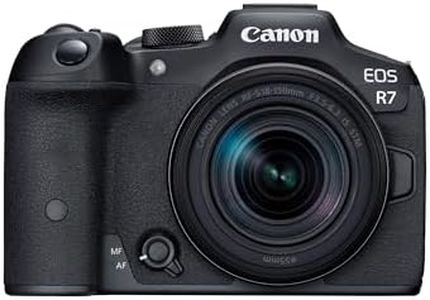
Canon Mirrorless Cameras EOS R7 + RF-S 18-150mm - w/o Mount Adapter GB - 32.5 MP APS-C CMOS Image Sensor - Dual Pixel CMOS AF II - In-Camera Compositing - LCD Touchscreen - UVC/UAC Compatible

9.7  score

Available on
£1,141.47
View Product
View more options
Rating
9.7
Burst Rate
Autofocus System
Sensor Size
Burst Rate
The camera excels in speed with a mechanical shutter shooting up to 15fps and an electronic shutter reaching 30fps, perfect for capturing fast-moving wildlife moments.
Autofocus System
Its autofocus system uses advanced AI to track subjects with impressive accuracy, locking onto eyes and maintaining focus on animals and action scenes.
Sensor Size
The 32.5-megapixel APS-C sensor delivers sharp, detailed images with excellent low-light performance, balancing resolution and clarity.
Lens Compatibility
While the native RF-S lens selection is still growing, the included versatile 18-150mm lens covers a broad range suitable for beginners starting in wildlife photography.
Ease of Use
Overall, the camera offers exceptional value with professional-grade autofocus, fast burst shooting, and high image quality in a user-friendly package.

The Canon EOS R7 paired with the RF-S 18-150mm lens is a strong choice for beginners interested in wildlife photography. It features a 32.5-megapixel APS-C sensor that balances good image quality with plenty of detail, making it easier to capture animals clearly even at a distance. The autofocus system is excellent, offering 425 focus points with Canon’s Dual Pixel CMOS AF II technology that uses AI to track fast-moving subjects reliably—important for wildlife shots. Its burst shooting speed is impressive, with up to 15 frames per second using the mechanical shutter and 30 fps electronically, so you won’t miss those action moments.

The included lens is versatile, covering wide to telephoto range (18-150mm) with optical image stabilization and smooth, quiet focusing, suitable for various outdoor scenes from landscapes to wildlife. However, the camera and lens lack formal weather sealing, so you’ll need to be cautious shooting in wet or dusty conditions. The design is beginner-friendly, with an intuitive touchscreen and helpful features like a joystick and an OVF assist mode for users transitioning from DSLRs. It supports Canon’s RF and EF-S lenses, giving room to grow your gear.

Although not the lightest option at around 840 grams, its solid build and steady image stabilizer make handheld shooting easier. This kit offers speedy performance, sharp images, and useful beginner controls, but wildlife photographers needing rugged weather resistance might want to consider extra protection.

Rating
9.7
Burst Rate
Autofocus System
Sensor Size
Burst Rate
The camera excels in speed with a mechanical shutter shooting up to 15fps and an electronic shutter reaching 30fps, perfect for capturing fast-moving wildlife moments.
Autofocus System
Its autofocus system uses advanced AI to track subjects with impressive accuracy, locking onto eyes and maintaining focus on animals and action scenes.
Sensor Size
The 32.5-megapixel APS-C sensor delivers sharp, detailed images with excellent low-light performance, balancing resolution and clarity.
Lens Compatibility
While the native RF-S lens selection is still growing, the included versatile 18-150mm lens covers a broad range suitable for beginners starting in wildlife photography.
Ease of Use
Overall, the camera offers exceptional value with professional-grade autofocus, fast burst shooting, and high image quality in a user-friendly package.

Buying Guide for the Best Wildlife Photography Cameras For Beginners

Choosing the right camera for wildlife photography as a beginner can be an exciting journey. The key is to find a camera that balances ease of use with the ability to capture high-quality images of fast-moving and often distant subjects. You'll want a camera that can handle various lighting conditions and has features that help you learn and grow as a photographer. Consider what kind of wildlife you are most interested in photographing, as this can influence the type of camera and lenses you might need. Remember, the best camera is one that you feel comfortable using and that inspires you to get out and take photos.
Sensor SizeThe sensor size in a camera determines how much light it can capture, which affects image quality, especially in low-light conditions. Larger sensors, like full-frame or APS-C, generally provide better image quality and more detail. For wildlife photography, a larger sensor can be beneficial as it allows for better performance in varying light conditions and more flexibility in cropping images. Beginners might start with an APS-C sensor, which offers a good balance between quality and cost, and provides a crop factor that can be advantageous for getting closer to distant subjects.
Autofocus SystemThe autofocus system in a camera helps you quickly and accurately focus on your subject, which is crucial in wildlife photography where subjects can move unpredictably. A good autofocus system will have multiple focus points and modes to track moving subjects. For beginners, look for a camera with a reliable and fast autofocus system that offers continuous autofocus tracking. This will help you capture sharp images of animals in motion, making it easier to get those perfect shots.
Burst RateBurst rate, or frames per second (fps), refers to how many images a camera can take in a quick succession. This is important in wildlife photography to capture fast-moving action, like a bird in flight. Cameras with higher burst rates allow you to take multiple shots in a short period, increasing your chances of getting the perfect shot. Beginners should look for a camera with a decent burst rate, around 5-10 fps, which is usually sufficient for most wildlife scenarios.
Lens CompatibilityLens compatibility refers to the range of lenses that can be used with a camera. In wildlife photography, having a good telephoto lens is essential to capture distant subjects. When choosing a camera, consider the availability and variety of lenses that are compatible with it. Beginners should look for a camera system that offers a wide range of lenses, especially telephoto options, to allow for growth and flexibility in their photography journey.
Weather SealingWeather sealing in a camera protects it from dust, moisture, and other environmental elements, which is important for wildlife photography often done outdoors. A camera with good weather sealing will be more durable and reliable in various weather conditions. Beginners should consider a camera with some level of weather resistance, especially if they plan to shoot in diverse environments, ensuring that their equipment can withstand the elements.
Ease of UseEase of use refers to how intuitive and user-friendly a camera is, which is crucial for beginners who are still learning the ropes. A camera with a simple interface, helpful guides, and automatic modes can make the learning process smoother. Beginners should look for a camera that offers a good balance between manual controls for learning and automatic settings for ease, helping them gradually improve their skills without feeling overwhelmed.