We Use CookiesWe use cookies to enhance the security, performance, functionality and for analytical and promotional activities. By continuing to browse this site you are agreeing to our privacy policy

10 Best Power Inverters

From leading brands and best sellers available on the web.
By clicking on a link to a third party's website, log data is shared with that third party.

Our Top Picks

#1

Winner

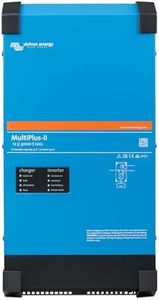
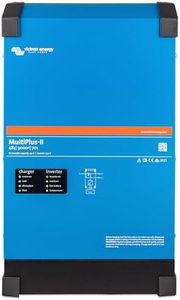
Victron Energy MultiPlus-II - Power Inverter - Pure Sine Wave Inverter Charger for 70 amp Battery - with PowerAssist Technology - 5000VA 48-Volt 230V

The Victron Energy MultiPlus-II Pure Sine Wave Inverter Charger is a robust option for those needing a reliable power solution, particularly in professional marine, vehicle, and off-grid settings. It offers a continuous wattage of 4000 watts, making it suitable for powering a range of devices. The pure sine wave output ensures compatibility with sensitive electronics, providing stable and efficient energy transfer. One of its standout features is the PowerAssist function, which prevents AC source overload, a valuable asset when dealing with limited power sources such as generators.

This inverter charger is designed for versatility and scalability, as it allows parallel operation of up to six units, significantly increasing power capacity. This makes it highly adaptable for larger setups. Additionally, its quick response time of 20ms during power outages ensures that connected loads are supplied seamlessly, which is crucial for maintaining continuous power in critical applications.

However, the product is not without its drawbacks. At 29 kg, the weight is a consideration for portability, particularly in mobile applications like RVs. The installation might be complex for users without technical expertise, potentially requiring professional assistance. Moreover, its efficiency, while generally good, may not be the highest compared to other models in its class, which might affect performance in energy-critical scenarios.

In terms of safety, the built-in anti-islanding feature and support for an external current transformer enhance its operational safety and energy management capabilities. Despite its strengths, potential buyers should weigh these features against its size and installation complexity to ensure it fits their specific needs.

#2

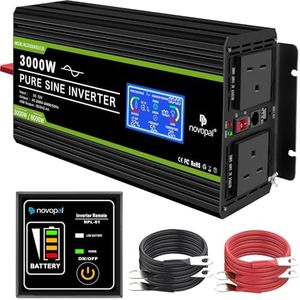
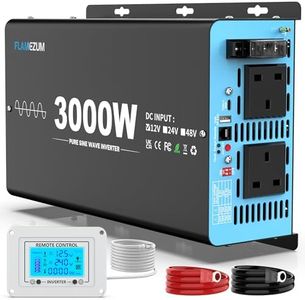
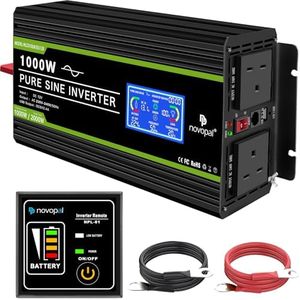
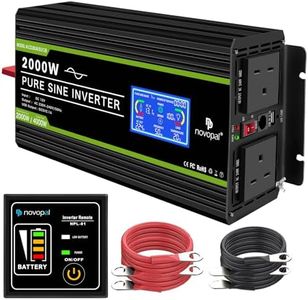
NOVOPAL Pure Sine Wave Inverter 3000W 12V to 230V 240V Car Converter Power Inverter with LCD Display 2AC Outlets,2.4A USB Port,Remote Control for Motorhomes,Truck,Boat,Camping,Household,Van

Rating
9.7
Wattage
Continuous vs. Peak Power
Efficiency
Wattage
The inverter effortlessly powers high-demand devices like a 2000W kettle without overheating.
Continuous vs. Peak Power
The inverter is praised for its low standby current draw and capability to start high power appliances like freezers.
Efficiency
The inverter is impressively well-made, efficient, and unobtrusive in operation.
Safety Features
The device boasts a soft start feature and stable output voltage and frequency.

The NOVOPAL Pure Sine Wave Inverter is notable for its 3000W continuous power output and a peak power of 6000W, making it ideal for powering appliances such as drills, microwaves, and refrigerators. It efficiently converts 12V DC to 230V/240V AC, making it suitable for use in motorhomes, trucks, boats, and camping situations. With a pure sine wave output, it supports sensitive electronics requiring clean power.

Equipped with 2 AC outlets and a USB port, the inverter allows for powering multiple devices at once. The remote control and LCD display offer added convenience by enabling users to monitor battery levels, voltage, and operational status from a distance. Smart cooling fans activate only when necessary, minimizing noise during low power use.

Weighing 6.72 kg with dimensions of 42 x 16.5 x 10 cm, it may be considered bulky, which could be a concern for those with limited space or portability requirements. While it includes essential safety features like overvoltage and overload protection, this inverter is particularly beneficial for those needing dependable power conversion in off-grid situations.

Rating
9.7
Wattage
Continuous vs. Peak Power
Efficiency
Wattage
The inverter effortlessly powers high-demand devices like a 2000W kettle without overheating.
Continuous vs. Peak Power
The inverter is praised for its low standby current draw and capability to start high power appliances like freezers.
Efficiency
The inverter is impressively well-made, efficient, and unobtrusive in operation.
Safety Features
The device boasts a soft start feature and stable output voltage and frequency.
#3

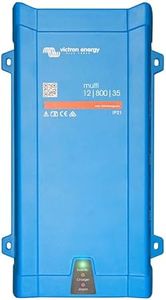
Victron Energy MultiPlus-II - Power Inverter - Pure Sine Wave Inverter Charger for 70 amp Battery - with PowerAssist Technology - 3000VA 24-Volt 230V

Rating
9.7
Waveform Type
Efficiency
Safety Features
Waveform Type
The inverter’s clean, stable pure sine wave output ensures sensitive electronics operate safely and efficiently.
Efficiency
PowerAssist technology effectively prevents overloads when connected to limited power sources, enhancing system resilience.
Safety Features
Safety features like anti-islanding provide peace of mind by protecting utility workers during outages.

The Victron Energy MultiPlus-II is a solid choice for anyone needing a reliable power inverter, especially for marine, off-grid, or vehicle use. It offers 3000 watts of continuous power at 24 volts, which is suitable for running medium to large appliances or tools. The pure sine wave output is a big plus because it provides clean, stable power that's safe for sensitive electronics. One standout feature is PowerAssist technology, which helps prevent overloading when connected to limited power sources like generators or shore power by supplementing the power drawn from these sources.

This inverter also switches on very quickly (within 20 milliseconds) if the main power fails, ensuring your devices stay powered without interruptions. You can even connect up to six units in parallel for higher power needs or create a three-phase system, which is useful for larger or more complex setups. It’s efficient and packed with safety features, including anti-islanding, which protects utility workers during outages. At about 18 kg, it’s reasonably portable for its class but may require some effort to install.

Some users might find it complex if they only need a simple inverter, but for those looking for a robust, feature-rich solution, especially in marine or off-grid contexts, this model performs very well.

Rating
9.7
Waveform Type
Efficiency
Safety Features
Waveform Type
The inverter’s clean, stable pure sine wave output ensures sensitive electronics operate safely and efficiently.
Efficiency
PowerAssist technology effectively prevents overloads when connected to limited power sources, enhancing system resilience.
Safety Features
Safety features like anti-islanding provide peace of mind by protecting utility workers during outages.

Buying Guide for the Best Power Inverters

Choosing the right power inverter can be a bit daunting, but with the right knowledge, you can find the perfect fit for your needs. Power inverters convert DC (direct current) power from sources like car batteries or solar panels into AC (alternating current) power, which is what most household appliances use. Understanding the key specifications will help you make an informed decision and ensure that the inverter you choose meets your power requirements and usage scenarios.
WattageWattage indicates the total power output that the inverter can handle. This is crucial because it determines what and how many devices you can run simultaneously. Inverters come in various wattage ratings, typically ranging from 150 watts to several thousand watts. For small devices like laptops and phone chargers, a lower wattage inverter (150-300 watts) is sufficient. For larger appliances like microwaves or power tools, you will need a higher wattage inverter (1000 watts or more). Assess the total wattage of the devices you plan to use and choose an inverter that can handle that load.
Continuous vs. Peak PowerContinuous power is the amount of power the inverter can supply on a regular basis, while peak power is the maximum power it can provide for a short burst, usually to start a device with a high initial power draw. This is important because some devices, like refrigerators or pumps, require a higher power surge to start up. When selecting an inverter, ensure that its continuous power rating meets your regular usage needs and that its peak power rating can handle the startup requirements of your devices.
Waveform TypeInverters produce different types of waveforms: pure sine wave, modified sine wave, and square wave. Pure sine wave inverters produce power that is identical to or better than the power supplied by the grid, making them suitable for sensitive electronics and medical equipment. Modified sine wave inverters are less expensive and work well for most household appliances, but may not be suitable for sensitive devices. Square wave inverters are the least expensive and least efficient, typically used for simple tools and devices. Choose a pure sine wave inverter for sensitive electronics and a modified sine wave inverter for general household use.
Input VoltageInput voltage refers to the voltage required from the DC power source, commonly 12V or 24V. This is important because it needs to match the voltage of your power source, such as a car battery or solar panel system. Most car batteries provide 12V, so a 12V input inverter is suitable for automotive use. For larger solar power systems, a 24V input inverter may be more appropriate. Ensure the input voltage of the inverter matches your power source to avoid compatibility issues.
Number and Type of OutletsThe number and type of outlets on an inverter determine how many devices you can connect and what types of plugs are supported. Inverters typically come with a combination of AC outlets, USB ports, and sometimes DC outlets. Consider the types of devices you plan to use and ensure the inverter has enough outlets to accommodate them. For example, if you need to charge multiple devices simultaneously, look for an inverter with multiple AC outlets and USB ports.
EfficiencyEfficiency refers to how well the inverter converts DC power to AC power, with higher efficiency meaning less energy is wasted. This is important for maximizing the use of your power source, especially in off-grid or battery-powered situations. Inverters typically have efficiency ratings between 85% and 95%. Higher efficiency inverters are more desirable as they provide more usable power and reduce energy loss. Look for an inverter with a high efficiency rating to ensure optimal performance.
Safety FeaturesSafety features protect both the inverter and your devices from damage. Common safety features include overload protection, short circuit protection, over-temperature protection, and low voltage shutdown. These features are important to prevent damage to the inverter and connected devices, and to ensure safe operation. Choose an inverter with comprehensive safety features to protect your investment and ensure reliable performance.