10 Best Microscopes
From leading brands and best sellers available on the web.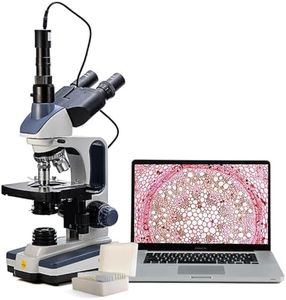
Related Products

Recommended lists
Usb Microscopes
Our Top Picks
Winner
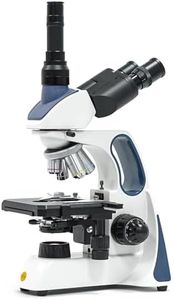
Swift SW350T Composite Trinocular Microscope, 40-2500X Magnification, Dual Layer Mechanical Stage, with 5.0MP Camera and Software, Windows/Mac Compatible and 5 Pack Prepared
The Swift SW350T compound trinocular microscope offers a versatile magnification range from 40X up to 2500X, covering most needs for detailed specimen viewing whether you are a student, hobbyist, or professional. Its optical system includes four high-quality achromatic objectives and two wide-field eyepieces (10X and 25X), which help deliver clear, sharp images. The trinocular head is a strong plus, allowing the attachment of the included 5MP camera for capturing and sharing images or videos, with user-friendly software compatible with both Windows and Mac.
Illumination comes from an adjustable LED light paired with an Abbe condenser, providing bright, even lighting essential for clear viewing. The two-layer mechanical stage with secure slide holders makes it easier to move and focus on specimens smoothly. The ergonomic design with a tilted head reduces neck strain, which is helpful during extended use.
The camera offers good resolution for basic imaging, but it may not satisfy users needing very high-detail photo quality. The package is relatively heavy (over 4 kg), which might limit portability. Also, as with many compound microscopes, beginners might face a learning curve to fully utilize the adjustable features. This microscope is a solid choice for educational settings and medical labs that require reliable magnification and digital imaging, providing a good balance of features for its price range.
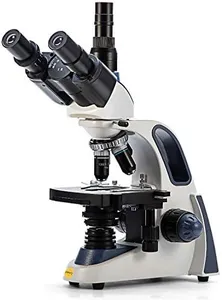
SWIFT SW380T 40X-2500X Magnification, Siedentopf Head, Research-Grade Trinocular Compound Lab Microscope with Wide-Field 10X/25X Eyepieces, Mechanical Stage, Ultra-Precise Focusing, Camera-Compatible
The SWIFT SW380T microscope is a versatile tool suitable for a range of users, from students and hobbyists to clinicians. Its standout feature is the impressive magnification capability, ranging from 40X to 2500X, allowing for detailed examination of specimen slides. The professional-grade Siedentopf head is designed for comfort, reducing neck strain with its 30-degree tilt and allowing for easy adjustment to different interpupillary distances. This feature makes it user-friendly, especially for shared environments.
The microscope includes six magnification levels through its 4 DIN Achromatic objectives, offering flexibility to observe various specimen details. The trinocular design is a strong point, accommodating additional eyepieces or a microscope camera, useful for those interested in capturing or livestreaming their observations. One of the most appreciated features is its ultra-precise focusing system, which supports both coarse and fine adjustments, crucial for achieving clear images at high magnifications. The mechanical stage further enhances the user experience by allowing precise control over slide positioning.
While the LED illumination provides adequate lighting, some users might find it less powerful compared to other high-intensity light sources. Additionally, the camera attachments needed for recording are not included, which could be an extra cost for those looking to utilize this function. Weighing 4.3 kilograms, the microscope is relatively portable, though the size might still be bulky for personal use outside a dedicated space. The build quality, incorporating metal and PE materials, contributes to its durability. This microscope is ideal for those looking for a reliable, research-grade tool that balances professional features with user-friendly operation.
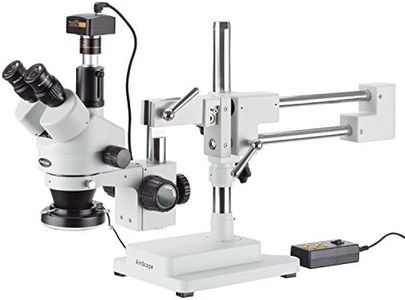
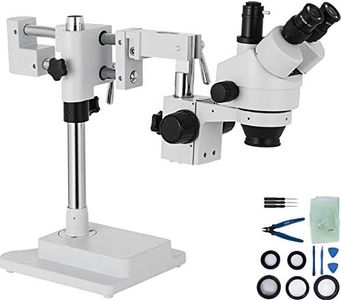
AmScope 3.5X-90X Trinocular Stereo Microscope with 4-Zone 144-LED Ring Light + 10MP Camera
The AmScope 3.5X-90X Trinocular Stereo Microscope offers a wide zoom range from 3.5 to 90 times magnification, making it versatile for viewing various objects with good detail. Its achromatic lenses provide clear images, and the large 8-inch working distance is helpful when you need space to handle specimens or tools under the lens. The built-in 4-zone 144-LED ring light is powerful and adjustable, ensuring bright and even illumination for clear viewing.
The 10MP USB camera lets you easily capture and share high-resolution images, which is great for both hobbyists and professionals. The 3D boom stand allows flexible positioning of the microscope head, adding convenience when examining larger or oddly shaped samples. It is relatively heavy and bulky, so it might not be the best choice if you need something very portable.
While the maximum magnification is 90x, it may not be sufficient for extremely fine details that specialized compound microscopes provide. This model suits users needing a sturdy stereo microscope with good lighting and imaging capabilities, such as educators, hobbyists, or industrial inspectors.